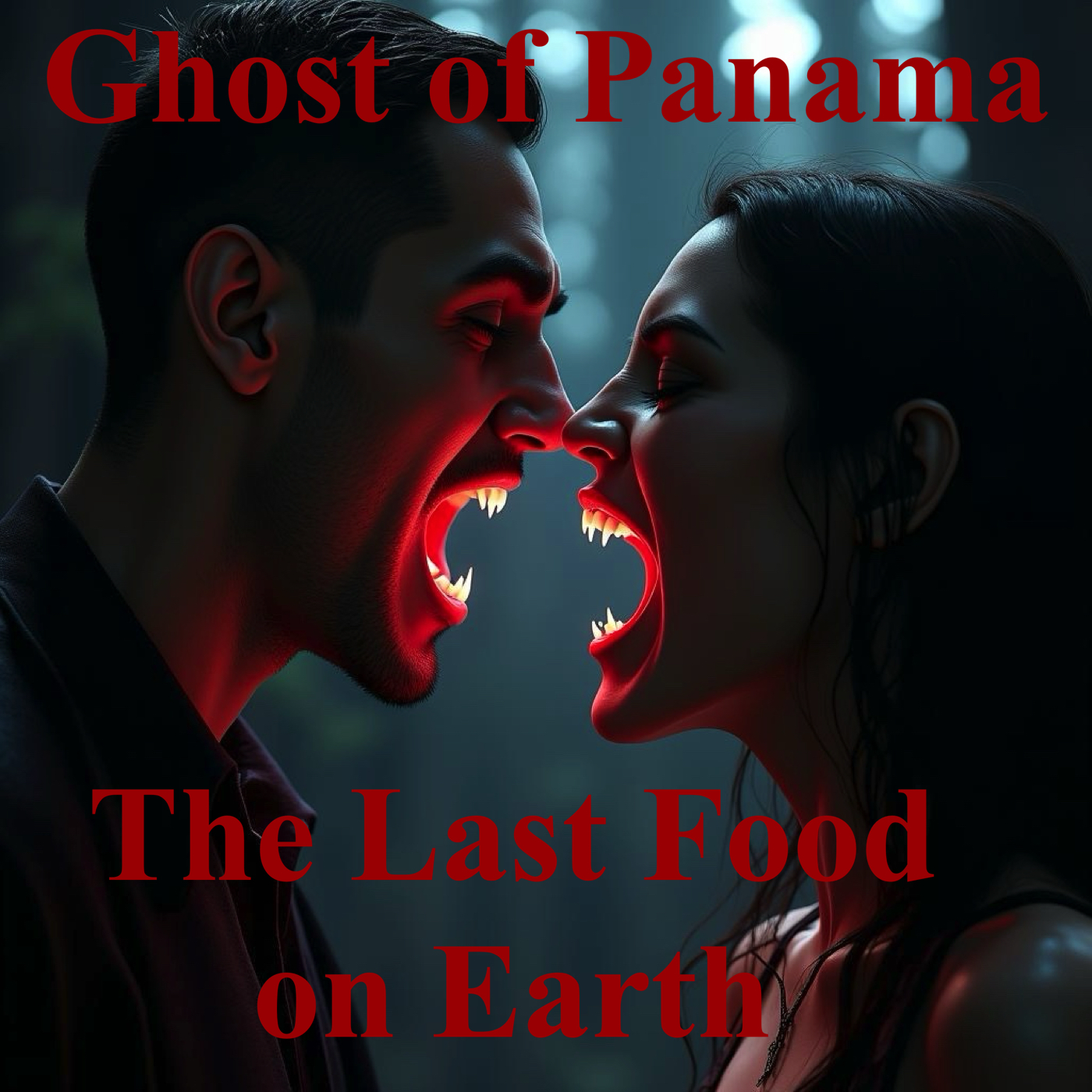
Concept albums often struggle to balance narrative ambition with genuine emotional impact, but Ghost of Panama achieve that balance remarkably well on The Last Food on Earth. The London duo of Keith Welham and Cristabel Liu have spent the past few years refining a sound that draws subtle inspiration from post-punk, alternative rock, and atmospheric art-pop without becoming derivative. Rather than relying on nostalgia, they use those influences as a foundation for something distinctly contemporary. Across ten carefully sequenced tracks, the album follows the emotional anatomy of a relationship—from entrapment and denial to guilt, acceptance, uncertainty, and, finally, hope. It is a record that rewards listeners who experience it from beginning to end, allowing each song to build naturally into the next while maintaining enough individuality to stand on its own. The production is equally compelling, particularly in its use of found sounds recorded around London, giving the record an organic texture that feels alive. Nowhere is this more striking than on “Half-Life,” where breathing and the unsettling clicks of a Geiger counter replace traditional drums, transforming rhythm into atmosphere. Meanwhile, more accessible tracks such as “Ghost of Your Perfume” and “Damage” provide melodic entry points before the expansive soundscapes of “Siberia” and “Island” widen the album’s emotional and sonic horizons.

What makes The Last Food on Earth particularly effective is its refusal to sacrifice songwriting in pursuit of concept. Every composition serves the larger narrative while remaining emotionally engaging on its own. “The Lift” introduces the emotional confinement that defines the opening act, while “Stockholm Syndrome Reversed” cleverly explores psychological conflict through layered instrumentation and lyrical ambiguity. “The Ultimate Maybe” captures indecision with remarkable subtlety, allowing uncertainty itself to become part of the music’s momentum. Throughout the record, Ghost of Panama avoid dramatic excess, choosing restraint over spectacle and allowing silence, texture, and carefully constructed arrangements to communicate just as much as the lyrics. Keith Welham and Cristabel Liu demonstrate an impressive understanding of pacing, ensuring that every transition feels intentional rather than forced. Recorded primarily in a small West London project studio, the album possesses an intimacy that contrasts beautifully with its cinematic ambitions, proving that innovation often comes from creativity rather than scale. Even during its most experimental moments, the music remains emotionally grounded, inviting listeners to interpret the songs through their own experiences instead of prescribing a single meaning.
The album reaches its emotional destination with “North Star,” an expansive and uplifting finale that feels genuinely earned after the emotional weight carried by the preceding nine tracks. Rather than offering an easy resolution, Ghost of Panama leave listeners with cautious optimism, suggesting that healing is less about forgetting the past than finding a direction beyond it. That sense of cohesion is what ultimately separates The Last Food on Earth from many modern releases. It functions not simply as a playlist of songs but as a complete artistic statement where sequencing, production, storytelling, and atmosphere work together with impressive precision. Ghost of Panama continue to establish themselves as one of London’s most intriguing independent acts, demonstrating that ambitious ideas can still be accessible when supported by thoughtful songwriting and inventive musicianship. The Last Food on Earth is an immersive listening experience that encourages reflection long after the closing notes fade, revealing new emotional details with every revisit.
About the Author


 English