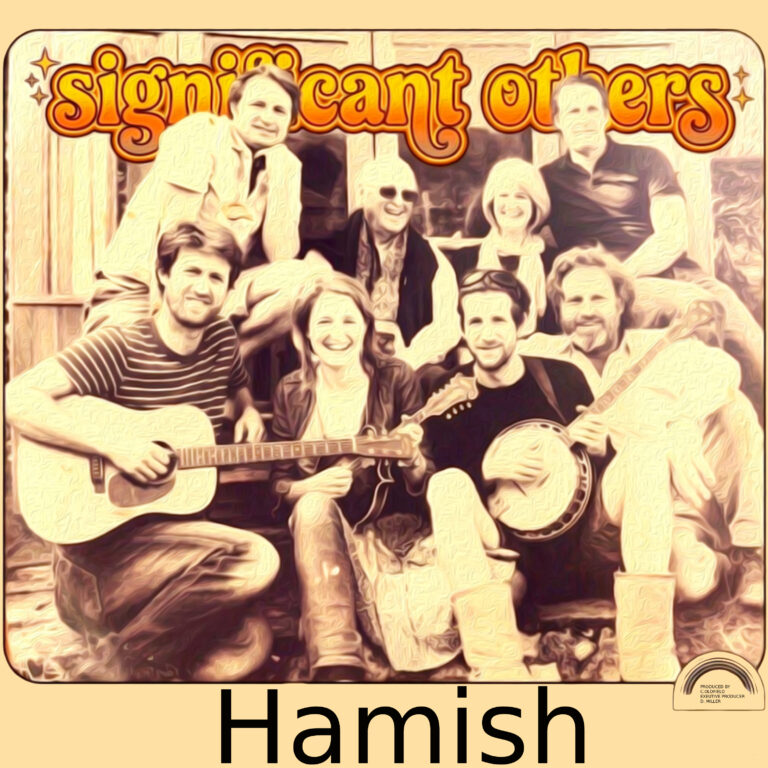
The album Hamish’s Significant Others has an incredibly rich background, but what is most important is the way that background is naturally reflected in the music. It was first put together in 2012 before being lost in a heap of cuttings and was later found again, gone over and given its final form with the assistance of producer Chris Oldfield, who was previously with Dreadzone. The outcome is a very personal collection based on Hamish’s simple belief in ‘good melodies and good words’. Starting with the first tracks ‘I’d Never Make It Through’ and ‘Bruhaha’ and continuing through to ‘Funny One’, ‘Borrowed Time’ and ‘The Worm Forgives The Plow’, there is a strong focus on songwriting rather than on showing off. Since Hamish has been involved in the UK music scene for decades, this is evident in the songs which sound as if they have been lived with, are melodic and full of character.
The main emotional aspect of the album Significant Others is due to the inclusion of the people and the experiences behind its songs. The songs “Helpless”, “I’m Prepared To Wait” and “Love All Around” were written for Hamish’s three children at the time they were born, which gives the album a sense of family history that goes well beyond that of a typical singer-songwriter record. In other cases, “Don’t Try And Break My Heart” has developed into a song that even his parents, who are in their eighties and nineties, enjoy dancing to, while “I’d Like To Say I’m Sorry”, “Close The Bedroom Door”, “Struggled” and “The End Is Always Hard” provide additional layers of vulnerability and reflection. His influences are just as diverse, extending from Bob Dylan, David Bowie, Al Stewart, Neil Young and Joni Mitchell to Queen, John Grant, Radiohead, Rufus Wainwright and even Verdi, whose influence makes a light appearance at the end of “Funny One”. Yet Hamish never sounds as if he is merely copying those artists; on the contrary, their influence becomes part of a songwriting style that has a clearly individual character.

The fact that the album was put together makes it all the more impressive. A large part of Significant Others was recorded in a cabin in Hamish’s garden, local musicians gathering round a fire-pit before taking part in the project, and ordinary resourcefulness played a role in the recording process—indeed, an empty tin filled with rice was used as part of the percussion. The surprise visit of Chris Oldfield, who had come to rent the cabin, eventually acted as the trigger for bringing the long-forgotten material back to life, the two of them using Ableton to dig out, polish and finish the recordings that had been lying around for years. The fact that Hamish had founded the Rabbit Hole at Glastonbury, where he had given support to up-and-coming artists from all different genres, adds another layer to an album which is already based on community and collaboration. Significant Others doesn’t just seem to be a set of songs finally being released after sixteen years; it is a musical time capsule containing family, friendship, perseverance, humour and the firm belief that a good melody and meaningful lyrics can survive almost anything.
“Significant Others” is the title of Hamish’s album, in which he turns his sixteen years of lost music into something timeless by rediscovering it and giving it a lovingly polished touch, so that family, friendship, memory and melody all end up forming one single story.
About the Author


 English