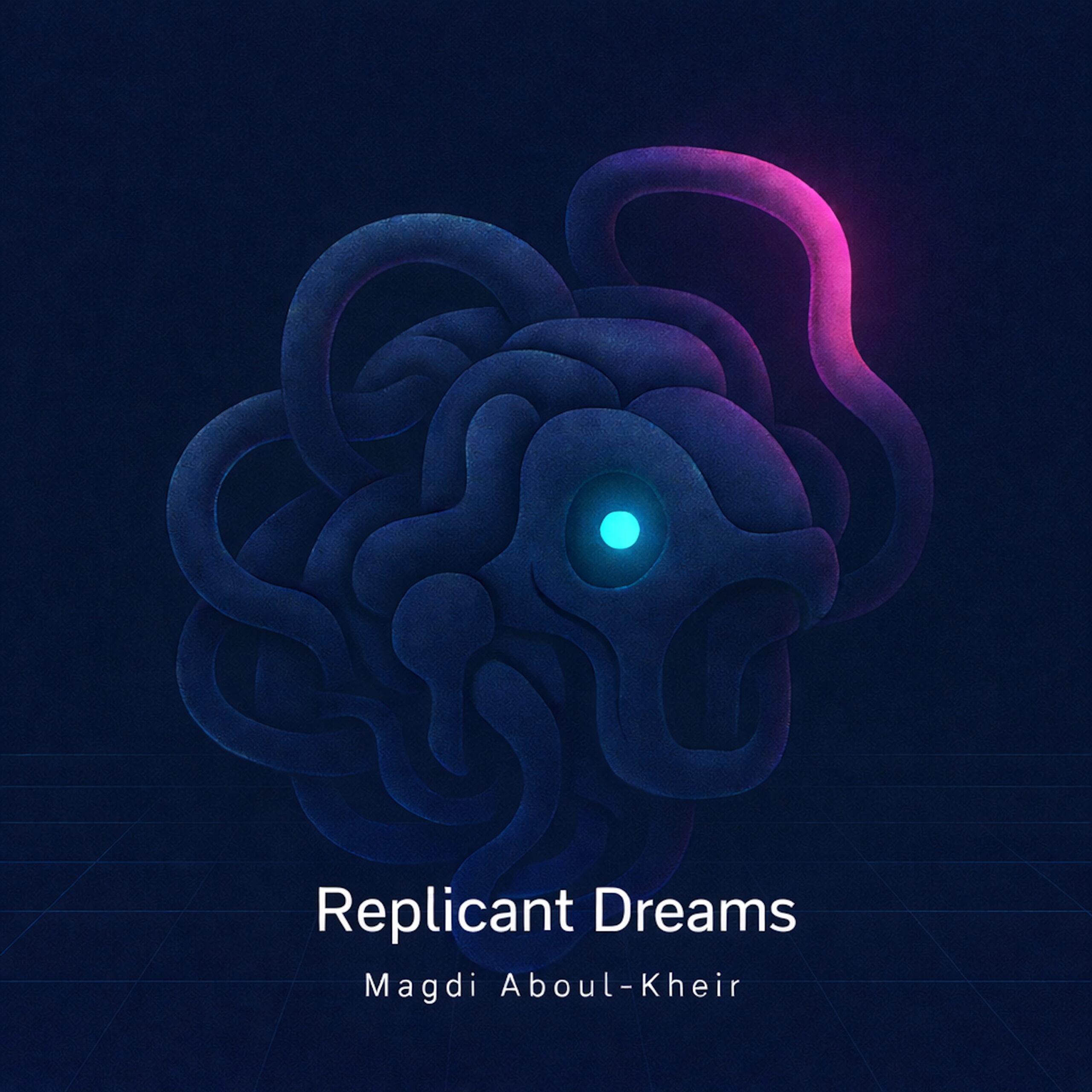
Magdi Aboul-Kheir Takes Listeners on a Retro-Futuristic Journey with “Replicant Dreams”
Magdi Aboul-Kheir’s Replicant Dreams is an album which makes use of the playful imagination associated with 1980s science fiction and at the same time imparts upon that well-known retro-futuristic setting a surprisingly deep emotional quality. Beginning with the pulse of “Vector Drive” and ending with the reflective mood of “Lunar Meditation”, the nine-song collection has the feel of a soundtrack to a fictional space adventure, featuring spaceships, light cycles, cyborgs and distant planets. Synthwave is central to the project, but Aboul-Kheir does not approach the use of retro synthesizers as simply a way of seeking nostalgia. On the contrary, he combines pulsating electronic rhythms with orchestral textures, cinematic arrangements and melodic themes that keep shifting between energetic, atmospheric, epic and romantic styles. The tracks “Orbital Beauty” and “Stardust Drift” convey the album’s more spacious character, whereas “Cyborg Legion” suggests a more mechanical and driving nature. The title track fits naturally in the middle of this world, balancing the futuristic textures with the melodic warmth that is present throughout the record. There is certainly a real sense of fun about it, but this is matched by a thoughtfully developed musicality which ensures that the album does not simply amount to a series of retro references.

The cinematic effect in Replicant Dreams is even more clear as the journey progresses through its various environments. “Leaving Earth” conveys a sense of departure and possibility, whereas “Stellar Metamorphosis” suggests transformation thanks to its wide use of electronic and orchestral sounds. “Deep Space Departure” goes even further in establishing a science-fiction atmosphere, giving the impression of moving beyond what is familiar, before “Lunar Meditation” offers a calmer and more reflective ending. Even though each track has its own character, the album functions very well as a whole experience because Aboul-Kheir recognises the value of melody. The fact that he is a classically trained pianist and his interests in baroque music, chamber and orchestral composition, minimalism, pop, jazz, ambient music and vintage electronics mean that the record has a wider musical vocabulary than its synthwave base at first appears. This variety enables him to move smoothly from energetic rhythms to delicate sections, from large cinematic moments to more personal and emotional ones, without losing the album’s main identity.
Replicant Dreams is in fact a development of the creative direction that Aboul-Kheir had previously pursued in projects like Into the Retroverse and Yesterday’s Future, though this time the scale appears to be greater and the storytelling more refined. The album succeeds in conveying two distinct things at the same time: the thrill of discovering an imagined future from the point of view of 1980s science fiction and the emotional effect of looking back on that imagined future from the present day. This gives the music a nostalgic atmosphere, but it is by no means static. Aboul-Kheir is obviously enjoying the sounds he is using, yet underneath all the spaceships and androids there is a composer who firmly believes in expressive melody. The outcome is an album that can be appreciated as a vibrant retro-electronic adventure and at the same time offers rewards to those who take notice of its orchestration, atmosphere and emotional changes. Ultimately, Replicant Dreams has the feel of a universe rather than just a series of songs — a universe full of movement, mystery, romance and sufficient melodic creativity to make the journey worthwhile.
“Replicant Dreams transforms its 1980s science-fiction nostalgia into a vibrant musical universe, with retro synthesizers, cinematic orchestration and true emotion all travelling among the stars.”
About the Author




 English