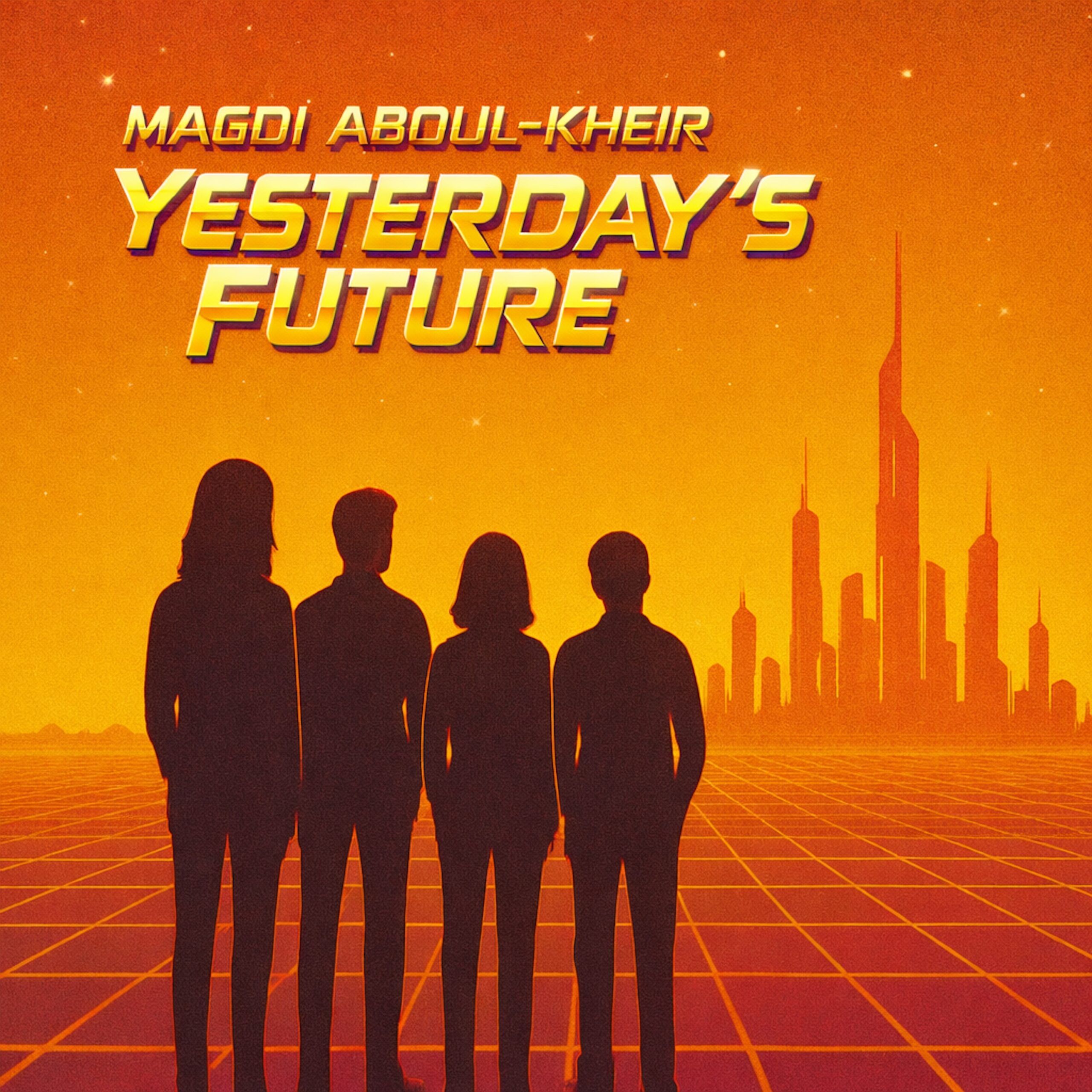
There is something wonderfully nostalgic about imagining the future through yesterday’s eyes. On Yesterday’s Future, Germany-based composer Magdi Aboul-Kheir embraces that idea with infectious enthusiasm, crafting a vibrant instrumental album that celebrates the optimistic sci-fi dreams of the 1980s. Across nine energetic tracks, he combines shimmering synthesizers, vintage drum machines, soaring electric guitars, and cinematic string arrangements into a collection that feels both comfortingly familiar and refreshingly modern.

Rather than simply recreating retro sounds, Aboul-Kheir captures the emotion behind them. This is the future imagined through neon lights, arcade cabinets, futuristic sports cars, and analog technology—a soundtrack to the era when tomorrow felt limitless. Yet beneath the nostalgia lies sophisticated songwriting rooted in one of the composer’s greatest strengths: memorable melody. Every composition has a clear identity, allowing the album to stand on its own rather than relying solely on vintage aesthetics. Opening track “Past Is Calling” immediately establishes the album’s mission with sparkling synth textures and uplifting hooks that invite listeners into its retro universe. “Machines’ Gym” follows with playful rhythmic energy, conjuring images of futuristic robots training to pounding electronic grooves, while “Endorphine Wave” delivers exactly what its title promises—an exhilarating burst of feel-good momentum driven by irresistible melodies. The atmospheric “Through the Neonrain” slows the pace slightly, surrounding listeners with glowing synth pads and cinematic ambience before “Pulsraum” injects fresh propulsion through pulsing electronic rhythms and dynamic instrumental interplay. At the centre of the album, the title track “Yesterday’s Future” perfectly encapsulates the project’s vision, blending nostalgic synthesizer textures with polished contemporary production to create a piece that feels timeless rather than dated. The emotional palette broadens with “Abyss of Shadows,” introducing darker harmonic colours without abandoning the album’s melodic core. This moment of introspection makes the triumphant brightness of “Sunburst” feel even more rewarding, its soaring guitar lines and radiant synthesizers creating one of the album’s most uplifting highlights.
Closing track “Life’s Journey” provides a satisfying conclusion, combining many of the album’s defining musical elements into an optimistic finale that reflects both nostalgia and hope. Rather than ending on sentimentality, Aboul-Kheir leaves listeners with a sense of forward momentum—an appropriate conclusion for an album built around the dreams of yesterday’s tomorrow. What makes Yesterday’s Future particularly engaging is its refusal to become trapped in retro imitation. Aboul-Kheir’s background as a classically trained pianist and his experience composing across orchestral, ambient, jazz, minimalism, and electronic genres allow him to treat vintage sounds as expressive tools rather than nostalgic gimmicks. His arrangements remain rich, polished, and emotionally engaging throughout, demonstrating genuine compositional craftsmanship beneath the colourful production. Following projects such as Into the Retroverse, The Garden of Make Believe, One Last Dance, and Nubes Sonorae, this release further showcases Aboul-Kheir’s remarkable versatility. Whether writing intimate piano works or expansive electronic instrumentals, his unwavering commitment to melody provides the common thread connecting his diverse catalogue. Yesterday’s Future succeeds because it reminds us why the sounds of the 1980s continue to inspire generations of musicians. It captures not only the aesthetics of that era but also its boundless optimism—the belief that music, technology, and imagination could shape a brighter tomorrow.
“Yesterday’s Future transforms retro nostalgia into an exhilarating cinematic adventure, proving that great melodies never go out of style—even when they’re borrowed from tomorrow’s past.”
Connect with Magdi Aboul-Kheir
About the Author



 English